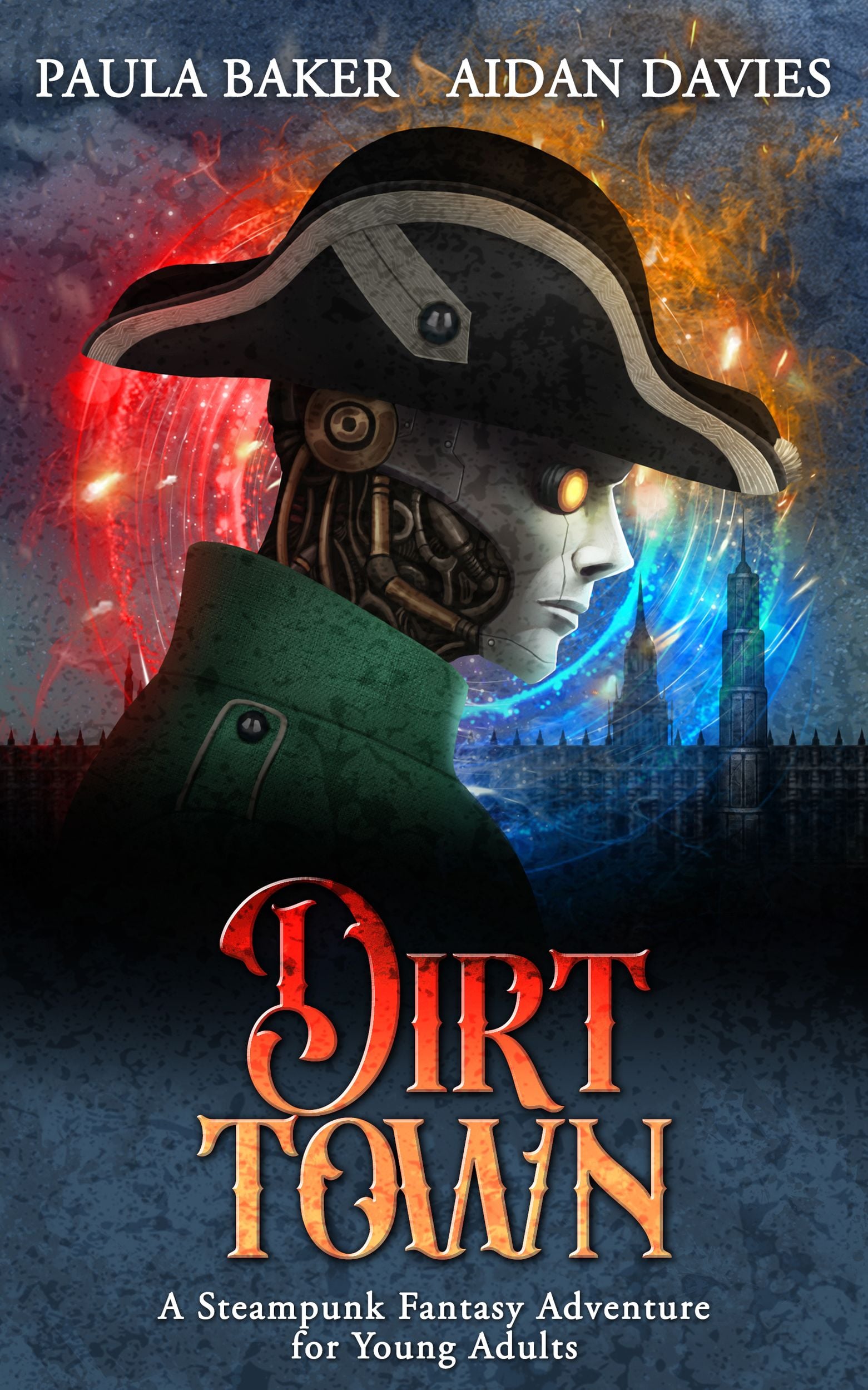
Dirt Town
A Standalone Steampunk Fantasy Adventure
Magic fuels privilege. Robots enforce oppression. One young doctor will ignite a revolution.
A mage on the run. A doctor with a conscience. A self-aware robot questioning his programming. A city on the brink.
Cairnisle appears prosperous and orderly on the surface. Its leaders promise stability, progress, and security.
But beneath the city lies Dirt Town, a hidden community built by generations of forgotten people.
When respected physician Aldrich Durante, orphaned mage Fiametta, and a self-aware City Guard robot uncover a conspiracy reaching from the halls of power to the depths below, they discover their city is built on dangerous secrets.
As old assumptions crumble and tensions rise, changing the future may require challenging the entire system.
Dirt Town is a standalone steampunk fantasy adventure filled with magic, mystery, revolution, hope, and unforgettable characters.
The Story
Two worlds. One city.
A revolution waiting to happen.
Get Dirt Town now.
What Readers Are Saying
★★★★★ “Perfect for YA steampunk fans, this book captivates readers from the first page."
★★★★★ “Exciting from start to finish."
★★★★★ “A fascinating world you have created with elements of magic, politics and robots."
★★★★★ “Great characters and lots of twists and turns."
Book at a Glance
Genre: Steampunk Fantasy
Format: Standalone Novel
Age Range: Teen and Adult Fantasy Readers
Pages: 410
Setting: Cairnisle and Dirt Town
Main Characters: Aldrich, Fiametta, Winston, Wilhelmina, Munash Conteh
Readers who enjoy steampunk fantasy, intelligent robots, hidden cities, and stories about justice and social change will find all of them in Dirt Town.
Perfect For Readers Who Enjoy
- Mistborn by Brandon Sanderson
- Foundryside by Robert Jackson Bennett
- The Aeronaut's Windlass by Jim Butcher
- Mortal Engines by Philip Reeve
- Arcane
Features
- Steampunk fantasy
- Intelligent robots
- A hidden city
- Political intrigue
- Found family
- Rebellion against injustice
Meet the Characters Heroes
Aldrich Durante
A respected young physician from the wealthy streets of Cairnisle, Aldrich has spent most of his life reading books and caring for patients. Intelligent, compassionate, and deeply curious, he begins to question everything he has been taught after meeting a young girl from Dirt Town. What starts as a chance encounter soon draws him into a struggle that will change his city forever.
Fiametta "Fia" Nardovino
Fourteen-year-old Fia grew up in Dirt Town, where survival depends on quick thinking and courage. Resourceful, fiercely independent, and gifted with forbidden magical abilities, she trusts few people and fears no one. Her determination, loyalty, and refusal to surrender make her one of the most memorable characters in the story.
Winston
Originally known as PI2-234, Winston is a City Guard robot designed to obey orders without question. A malfunction gives him something no robot should possess: the ability to think for himself. As Winston begins asking questions about freedom, loyalty, and right and wrong, he becomes one of the most unusual and beloved members of the group. Readers often cite Winston as one of the most memorable characters in the novel, thanks to his journey from programmed enforcer to self-aware ally.
Wilhelmina von Richtofen
Brilliant, dangerous, and impossible to predict, Wilhelmina moves between two very different worlds. To high society, she is the daughter of one of Cairnisle's wealthiest families. To others, she is the legendary Silver Assassin. Skilled, determined, and fiercely intelligent, she refuses to let anyone decide her future for her.
Allies
Munash Conteh
The unofficial leader of Dirt Town, Munash has earned the trust of the community through wisdom, compassion, and strength. A powerful mage and gifted strategist, he works tirelessly to create a better future for the people living beneath the city. Many in Dirt Town look to him for guidance when no one else will stand up for them.
Gustav Florenburg
A brilliant inventor whose creations transformed Cairnisle, Gustav understands robots better than anyone alive. After falling out of favour with the city's rulers, he becomes a crucial ally to those fighting for change. His inventions, creativity, and technical genius often prove as important as magic or swordsmanship.
Antogonists
Grand Magister Augustus Köhler
The powerful ruler of Cairnisle, Köhler believes order and stability must be maintained at any cost. His decisions shape the lives of everyone living both above and below the city streets.
Ingrid Jaeger
Ruthless, ambitious, and exceptionally dangerous, Ingrid Jaeger serves as the Magisters' second-in-command. Her willingness to push magic beyond moral limits makes her one of the story's greatest threats.
Forge-37
The most advanced robot ever built. Intelligent, adaptive, and frighteningly capable, Forge-37 sees himself as something superior to both machines and humans. As the conflict escalates, he emerges as one of the most formidable enemies the heroes must face.
Frequently Asked Questions
What is Dirt Town about?
Dirt Town is a standalone steampunk fantasy novel set in the city of Cairnisle. The story follows several characters whose lives become intertwined as they uncover dangerous secrets, confront corruption, and struggle to improve life for the people living in Dirt Town beneath the city.
Who is Winston?
Winston is a City Guard robot originally created to enforce the law. After gaining the ability to think independently, he begins questioning authority, freedom, and loyalty, eventually becoming one of the story's most important allies.
Why is Winston different from other robots?
Winston is a City Guard robot who develops the ability to think independently rather than blindly following his programming. His growing awareness forces him to question authority, morality, and what it means to be free.
Who is Forge-37?
Forge-37 is the most advanced robot ever created. Intelligent, adaptive, and capable of independent decisions, he sees himself as superior to humans and becomes one of the greatest threats facing Cairnisle.
Who is the Silver Assassin?
The Silver Assassin is the feared vigilante identity of Wilhelmina von Richtofen. While high society knows her as a wealthy aristocrat, the streets of Cairnisle know her as a deadly and mysterious figure operating in the shadows.
Why is magic outlawed in Cairnisle?
Magic is tightly controlled within Cairnisle, where powerful leaders view mages as both valuable resources and potential threats. As Aldrich and Fia uncover the truth behind the city's relationship with magic, they begin to question everything they have been taught.
Is Dirt Town part of a series?
No. Dirt Town is a complete standalone novel. Readers can enjoy the story without reading any other books first.
Is Dirt Town fantasy or steampunk?
Both. Dirt Town combines fantasy magic with steampunk-inspired technology, including automated vehicles, advanced machinery, and a society shaped by both magical and technological progress.
What is Dirt Town?
Dirt Town is the hidden community beneath the city of Cairnisle. Home to many of the city's poorest residents, it has developed its own identity, leaders, and sense of community far from the people who govern above.
Does Dirt Town contain magic?
Yes. Magic plays a major role in the story and includes powerful mages, magical training, mind-based abilities, and supernatural talents that influence the fate of the city.
Does Dirt Town contain romance?
Romantic relationships are not the primary focus. The story concentrates on adventure, friendship, community, mystery, justice, and personal growth.
Is Dirt Town appropriate for younger readers?
The novel is suitable for teen readers and older. It contains danger, political conflict, crime, and violence, but focuses primarily on adventure, mystery, and character development.
Is Dirt Town a clean fantasy?
Yes. The story emphasizes adventure, magic, friendship, and courage without relying on explicit content.
Does Dirt Town end on a cliffhanger?
No. Dirt Town is a standalone novel that tells a complete story with a satisfying resolution.
What books are similar to Dirt Town?
Readers who enjoy Mistborn, Foundryside, steampunk fantasy, hidden cities, political intrigue, and stories about friendship, justice, and social change will enjoy Dirt Town.
Get DIRT TOWN now.
A mage on the run.
A doctor with a conscience.
A city on the brink.
Magic is outlawed. Robots enforce the law with deadly precision. In Cairnisle, trust is a risk only the rich can afford.
Start the book...
If he positioned his book just right, Aldrich could harness the glow of the streetlamps, enabling him to read during his journey home. Having traversed the same path at dawn and dusk for the past four months, he had honed the skill to perfection.
That morning, he had begun a riveting book on psychological disorders. The narratives of the three individuals afflicted with an antisocial personality disorder had particularly piqued his interest. Despite the demands of his day, their chillingly callous psychopathic tendencies had lingered in his thoughts.
Upon reaching the streetcorner, where a shadow intersected the pools of light cast by a pair of streetlamps, he instinctively adjusted his course and continued onto his street, his reading undisturbed.
He paid no mind to the row of tall identical houses that lined the cobblestone footpath. Having scrutinized them thoroughly upon his arrival in the neighbourhood, they held no secrets for him.
The ground floor of each building was designed to accommodate a personal carriage. In his youth, horses had drawn those carriages, but times had changed. Horses were a rarity now. Many of his neighbours had installed steel rails that connected to the street tracks and vanished beneath wide double doors.
Aldrich, however, had felt no need to procure his own rig. He relished his walks to and from his medical clinic. For longer journeys, public conveyances were readily available and perfectly sufficient for his needs.
Beside each carriage house was a smaller door that opened onto a set of stairs and carried up to a level that accommodated a kitchen, a sitting room and a study. Above that were the bedrooms and bathrooms.
When Aldrich chose his house, he had appreciated that every home on the street was almost exactly identical. It was liberating to know that he was living just like everyone else. Each home provided sufficient room for an independent life and no more.
A clatter of hurried footsteps disrupted his concentration, and he glanced away from the words on the page.
A shabbily dressed girl, her dark hair an untidy mop, pelted around the corner and skidded to a halt beside him. Her presence was a stark contrast to the pristine street, yet she fell into step with Aldrich as though they were familiar companions.
His eyebrows drew together as he gazed down at her. “Can I assist you, miss?” he asked.
Her green eyes met his, round and pleading, as two equally unsavoury men pounded around the corner.
“There she is,” one called when they spotted the girl.
Coming to an abrupt halt, the shorter, stocky one planted himself in Aldrich’s path. “Here, you,” he growled through the unkempt moustache that hung over his mouth in a disagreeable manner. “Stand aside.”
The taller one, bald and dishevelled, hunched his shoulders and leaned in close. “She’s ours, she is,” he said, expelling a gust of foul breath into Aldrich’s face. “Hand her over.”
Aldrich noted his page number and gently closed the book, pursing his lips as he surveyed the wretched specimens of humanity who had materialized almost on his doorstep.
With a sweeping glance, the shorter man took note of the fine fabric of Aldrich’s rich blue coat and froze. His dark eyes lingered on the swirls of silver embroidery on the turned-up cuffs and the double row of silver buttons that Aldrich’s tailor had proudly drawn to his attention.
The ruffian raised both hands and stepped back. “Beg pardon, your honour,” he said, tugging at his greasy hair. “We was just looking for the girl.”
Aldrich lifted an eyebrow and glanced down at the girl.
She met his gaze and gave a covert shake of her head.
Unable to disregard the silent plea, Aldrich tucked the book under his arm and straightened to his full height that left him only slightly taller than the shorter of the two. Lifting his chin, he looked down his nose and frowned at the ruffians. “I do not believe this young lady wishes to accompany you,” he said.
“Of course, your honour,” the tall one said, casting a sharp glance at his partner. “We meant no harm.” He backed away with an awkward bow. Raising his head, he looked directly at the girl. “Excuse us, miss. We musta confused you with someone else.” With a smirk and a wink, he turned on his heel and retraced his steps.
The shorter man jutted out his chin and glowered at the girl before turning to follow his companion. Lifting a cheery hand, he called, “Perhaps we’ll meet again someday, miss. Until then.”
The unlikely pair retreated down the street, darting from shadow to shadow in a sinister reversal of Aldrich’s customary pursuit of light.
Rubbing his chin, he watched them depart before resuming his walk home.
The girl fell into step beside him, and he blinked down at her.
“Would you care to explain what just transpired?” he murmured.
Her eyes widened but she pressed her lips together and remained silent.
Aldrich frowned. “Come now,” he said. “I am certain you must have some explanation.” Spotting the blade gripped in her right hand, his head jerked back before his expression softened. He stretched out a hand toward her. “Did those men intend to harm you? Did you plan to defend yourself with that knife?”
She snorted and snapped the blade shut with a practiced flick of her wrist before sliding it into the pocket of her knee-length red coat. There was a small tear along the seam that suggested she often kept her hand close to the weapon. What sort of life did she lead that she felt the necessity of such a precaution?
Surveying the empty street, Aldrich hitched the psychology book higher under his arm and cleared his throat. “What will you do now?” he asked.
The girl seemed unable to blink, and her breathing had accelerated to rapid gasps. Was she ill? Or perhaps frightened?
Aldrich stared in the direction the men had disappeared. No doubt they had scurried back to the hole from which they had crawled.
The book was heavy, and he shifted it to his other hand. As he did, it occurred to him that it would make a formidable weapon. The corners of his lips lifted. Fighting words. That was amusing.
He was on the point of sharing the joke when he realized that the girl might not appreciate the irony. She was more likely to agree in a purely practical sense. After all, she had been prepared to fight.
He frowned. He could not abandon her to the mercy of those brutes. He looked up at the sky where the stars were dimly visible beyond the street lighting and let out a slow breath. There was no help for it.
“This is my home,” he said, gesturing to the house in front of which they had stopped. “It might be best if you stayed here tonight. Perhaps you will find the streets safer in the morning.”
Continue the adventure in
Dirt Town
A Steampunk Fantasy Adventure