
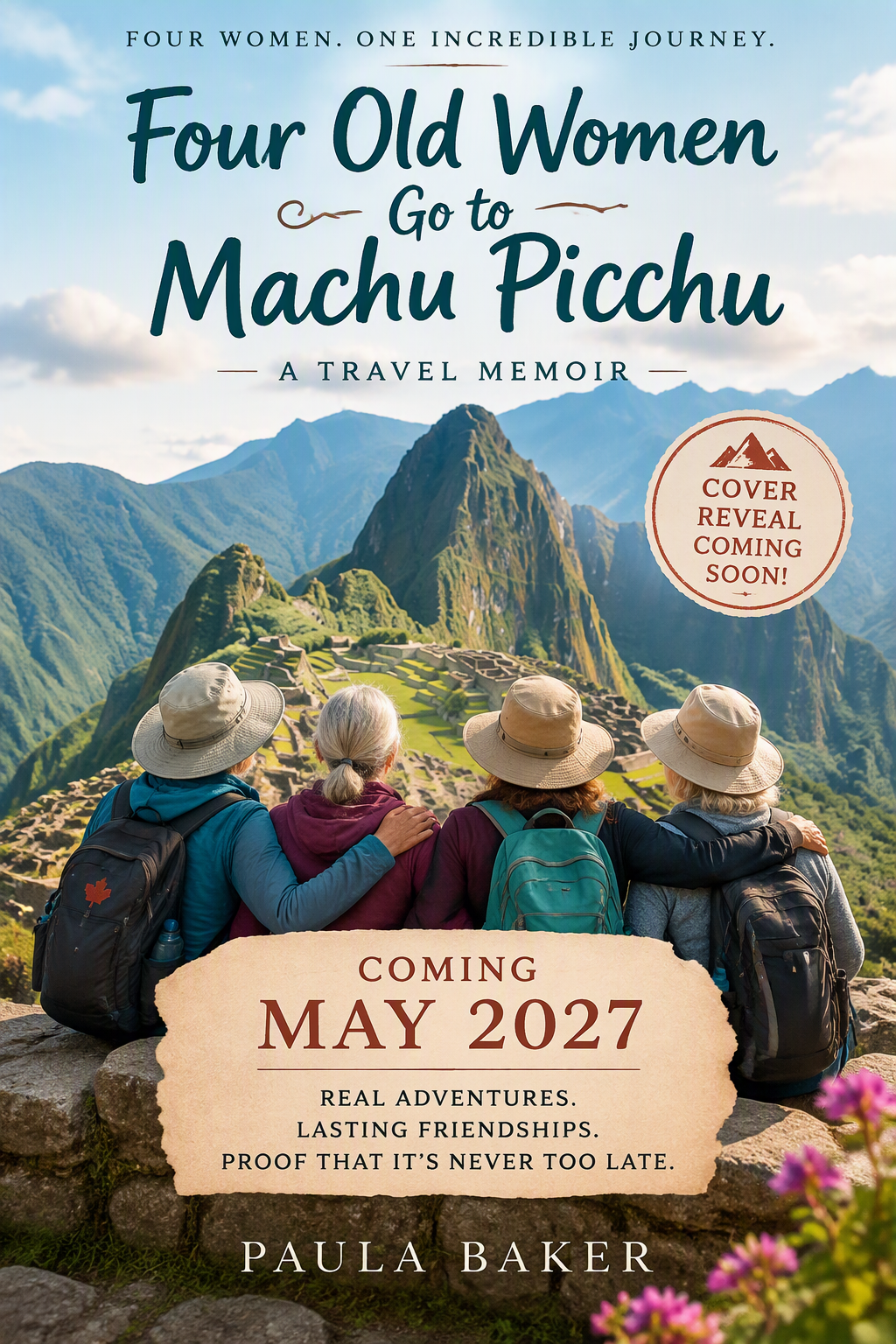
Four Old Women Go to Machu Picchu
Four women. So many mountains. One unforgettable adventure.
Four Canadian women in their sixties decided it would be a brilliant idea to hike the Inca Trail to Machu Picchu.
What followed was months of training hikes, planning sessions, nervous anticipation, questionable decisions, altitude, laughter, unexpected challenges, and one unforgettable journey through Peru.
Part travel memoir, part friendship story, and part celebration of saying yes to life's adventures, Four Old Women Go to Machu Picchu follows Jen, Holly, Margie, and Paula from the mountains of British Columbia to one of the world's most famous destinations.
Along the way, they discover that the most meaningful part of a journey isn't always the destination.
Sometimes it's the people who walk beside you.
Coming May 2027
👉 Join the launch list and be among the first to hear about cover reveals, advance reader opportunities, and publication updates.
What Early Readers Are Saying
★★★★★ “What a read! From the inception of the idea of travelling to Peru, through the training, organizing, immunizing, packing, departure, arrival, and the many eye-opening adventures, I was enthralled.”
★★★★★ "I delighted in the opportunity to experience this bucket-list trip through you and your companions' eyes and feet.”
Why Readers Connect With This Story
- Friendship and humour
- Hiking the Inca Trail
- Peru and Machu Picchu
- Active retirement
- Travel preparation and planning
- Real-world adventures
- Women's travel memoir
- Laugh-out-loud moments
- Personal growth without self-help clichés
Coming May 2027
Join the launch list and receive:
- Cover reveal updates
- Advance reader opportunities
- Behind-the-scenes updates
- A free copy of We're Not Getting Any Younger
👉 Click to Join the Launch List
Book at a Glance
Genre: Travel Memoir
Setting: British Columbia, Canada, and Peru including Lima, Cusco, the Sacred Valley, the Inca Trail, Machu Picchu, and Rainbow Mountain
Main Characters: Paula, Margie, Holly, and Jen
Publication Date: May 2027
Perfect For Readers Who Enjoy
- Walking with Sam by Andrew McCarthy
- A Walk in the Woods by Bill Bryson
- Travel memoirs
- Hiking and walking journeys
- Friendship stories
- Armchair travel
- Active retirement
- Peru and Machu Picchu
More Than a Travel Memoir
At first glance, this is a story about Peru.
But it is also a story about:
- Friendship
- Curiosity
- Confidence
- Aging well
- Adventure
- Learning to accept help
- Finding joy in unexpected places
If you've ever caught yourself saying:
“Maybe someday,"
this book may encourage you to start thinking differently.
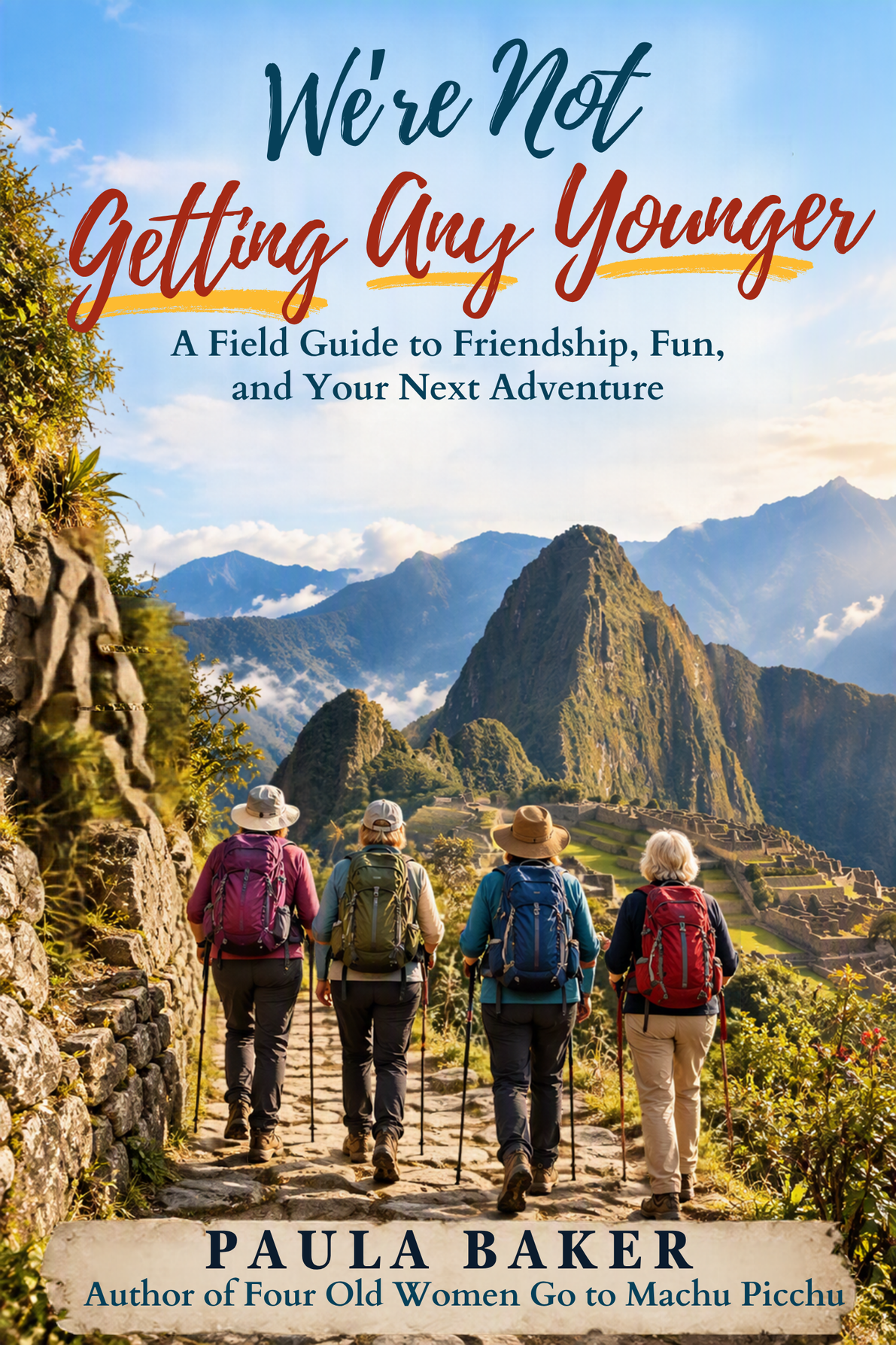
While you wait for publication, download:
We're Not Getting Any Younger
Life is a Time-LImited Offer
The free companion guide inspired by the travel memoir.
👉 Get Your Free Copy
Frequently Asked Questions
What is Four Old Women Go to Machu Picchu about?
Four Old Women Go to Machu Picchu is a travel memoir about four Canadian women in their sixties who spend seven months preparing to hike Peru's Inca Trail. Along the way they discover that friendship, laughter, and saying yes to adventure matter as much as reaching Machu Picchu itself.
Is this a true story?
Yes. Four Old Women Go to Machu Picchu is a true travel memoir that chronicles Paula Baker's journey through Peru and the Inca Trail and Rainbow Mountain with three close friends.
Do I need to be a hiker to enjoy it?
No. The story focuses as much on friendship, humour, and travel as it does on hiking.
Where does the story take place?
The memoir begins in British Columbia and follows the group to Peru, through Lima, Cusco, the Sacred Valley, the Inca Trail, and Machu Picchu.
Is this a travel guide?
No. It is a personal travel memoir rather than a guidebook, though readers will learn plenty about preparing for the journey and climb the stairs on the Inca Trail alongside the four old women and their guide, Holger.
When will the book be released?
Four Old Women Go to Machu Picchu is scheduled for publication in May 2027.
Who is Paula Baker?
Paula Baker is a Canadian writer, retired band teacher, librarian, traveller, cyclist, kayaker, skier, co-author of the Hawks fantasy novels, and author of Four Old Women Go to Machu Picchu.
Meet the Four Old Women
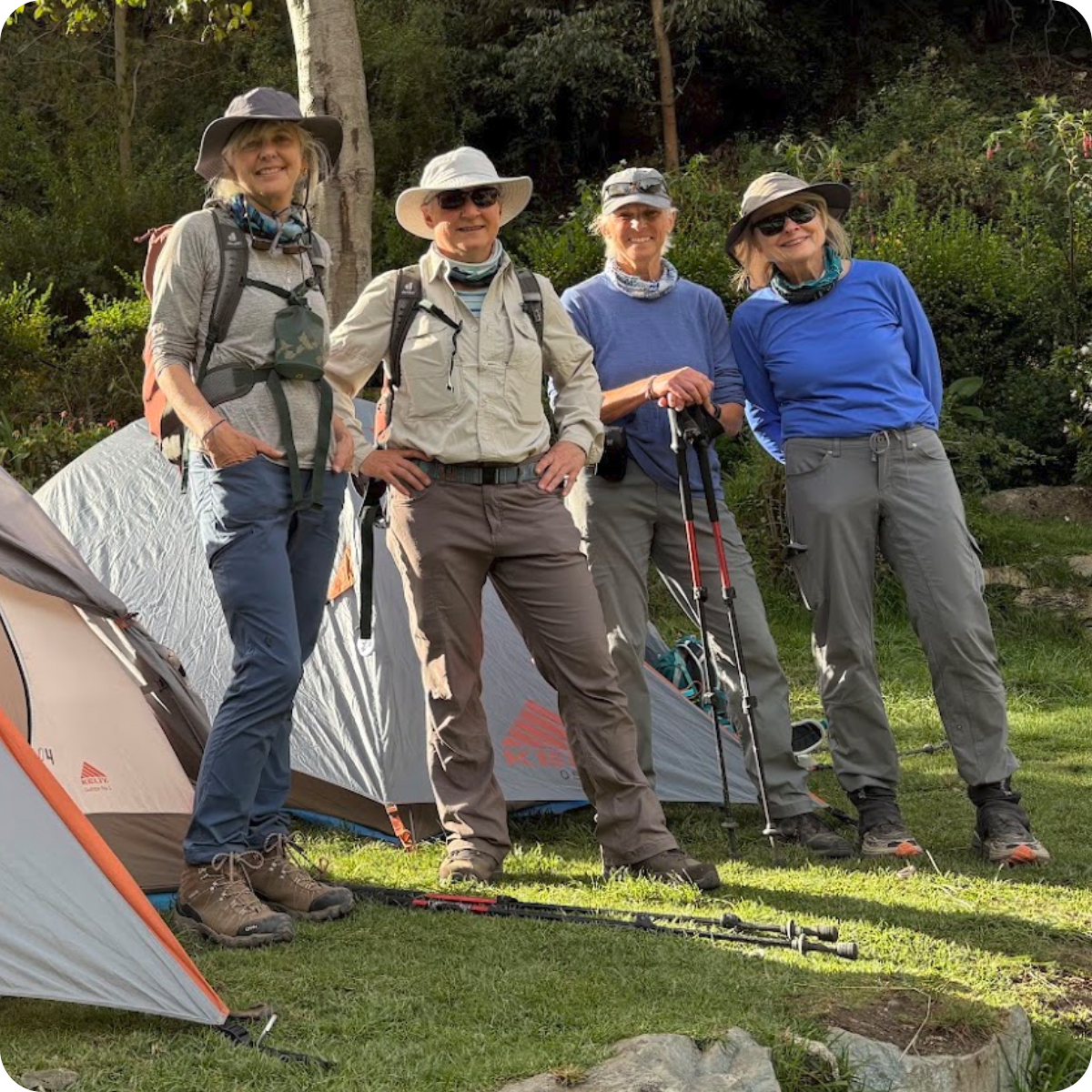
Margie, Paula, Holly, and Jen at the first campsite
Margie, Paula, Holly, and Jen spent years hiking, golfing, skiing, and exploring together before Machu Picchu entered the conversation. They share a love of the outdoors, a willingness to laugh at themselves, and a remarkable ability to turn even the smallest mishaps into great stories.
Paula
Retired band teacher, librarian, cyclist, kayaker, skier, musician, writer, and master of impractical ideas. She is the author of the travel memoirs Four Old Women Go to Machu Picchu and We're Not Getting Any Younger.
Margie
Retired French teacher, orchardist, and audiobook narrator, she has a flair for the dramatic. Many of the funniest stories in the book are, if not exactly at her expense, at least the direct result of her escapades.
Holly
Retired librarian and hiker extraordinaire, she never gets lost. It was her idea to go to Machu Picchu, and it turned out to be a very good one.
Jen
Retired kindergarten teacher, adventurer, fearless optimist, and the person most responsible for expanding everyone's vocabulary on the golf course.
Together, they set out to conquer the Inca Trail.
Four Old Women Go to Machu Picchu
A TRAVEL MEMOIR
The First Chapter...
216 Days to Go
As we watched the group in front of us meander down the fairway, we leaned on our drivers and waited our turn. It was one of those lazy golf‑course mornings when the biggest decision you face is which club to use and whether you should reapply sunscreen.
“Holly wants to go to Machu Picchu,” Jen said.
“I want to go to Machu Picchu,” I replied.
Where had that come from? Until that moment, Machu Picchu existed somewhere between Grade Six social studies and postcard fantasy—stone walls, llamas, a vague sense of mountains.
I’d never seriously considered going there. It wasn’t on any list. It wasn’t even an idea.
Blame the group ahead for making me wait. Idle me is dangerous. I’ll latch onto an idea and follow it all the way—even if it’s way up into the Andes.
Maybe it was turning sixty. Or maybe it was simply my rule never to say no to a good opportunity.
Whatever it was, something inside me sparked. I felt as if I’d just stepped onto a moving walkway. Machu Picchu was the obvious next thing to say yes to.
Holly and Jen are my hiking, skiing, and golfing buddies. After I retired, I went looking for people who wanted to go outside and play. I knew Holly through librarian meetings, so I called and asked if she wanted to golf. She said yes, and when I asked if she knew anyone else who might want to join us, she suggested Jen.
The women I had been playing with before were deeply committed to the game. They dressed in fancy golf outfits, matched their bags to their shoes, had sparkly ball markers, and knew every rule in the book. Plus, they were excellent golfers.
But I just wanted to whack and walk.
I had a few rules for my new crew.
First, we played ready-golf—no waiting around for etiquette reasons. Second, they had to tolerate my casual relationship with the rulebook. And third—no skorts.
They agreed.
Jen broke the skort rule almost immediately.
She’s a fashionista who loves to shop. She’s got a different skort for every day of the week. Holly even showed up one day in a borrowed skort—just because she could.
What was I going to do? Kick them out of my meticulously curated three-woman golf league?
The skort rule fell by the wayside.
Jen has been attempting to teach me to swear. When she hits a poor shot, she can blister the air—a remarkable talent for a former kindergarten teacher.
I’ve never mastered the art. When I miss, I laugh. If I look up and see the ball skying off in the wrong direction, it tickles my funny bone. It’s hard to laugh and remember to inject some profanity at the same time.
Jen and Holly are cousins who grew up in a village on Okanagan Lake where they started their education together in a one‑room school.
That’s a lie. They’re not that old.
There were at least four classrooms in their school. But they are the senior members of our group. Jen holds the distinction of being the eldest by eight months—although neither is anywhere near elderly.
Whatever their age, they were exactly the sort of people who would say yes to Machu Picchu.
I’d tackled more than one adventure with them. We paddled the Turner Lake Canoe Circuit in northern British Columbia during a summer so dry we spent more time carrying our canoes than sitting in them. We hauled the boats and the unwieldy gear along dusty portages, then celebrated at camp with potato chips and the wine Holly had decanted into her Camelbak.
Later came a hut-to-hut hike in Wells Gray Park where we congratulated ourselves on choosing a trip with real mattresses and actual bathrooms. After that, we flew by helicopter into the Valkyr Range and spent our days climbing peaks while our hosts worked miracles in the kitchen.
Each trip was strenuous and spectacular, and they convinced me that I should keep doing this sort of thing forever, or at least for as long as I could.
Eventually, the foursome ahead moved out of range.
Jen lined up her shot, gripped her driver, and swished her skort.
“Let’s do it,” she said as she stared down at her little pink ball. “Let’s go to Machu Picchu.”
Then she crushed her shot down the middle of the fairway.
That was it.
After golf, I went home, opened my laptop, and started a conversation with AI.
“I want to go to Machu Picchu with my friends,” I said. “We are all over sixty.”
The answer was completely unacceptable.
It suggested a train to Aguas Calientes, a bus to the entrance, and several gentle senior circuits where we could stroll and rest at our leisure—as though Machu Picchu were a shopping mall with benches.
What?
Being over sixty didn’t mean I was elderly. Did it?
I tried again. “We are strong, fit, and experienced hikers. We don’t want to take a bus.”
That’s when I discovered Wildland Trekking, a company that takes care of everything—except tying your boots for you. And honestly, I’m not convinced they wouldn’t help with that too.
You get a guide who knows the trail, the terrain, the altitude, and every ruin along the way. They handle the hotels, restaurants, buses, trains, permits, tickets, and schedules—the sort of mind‑numbing logistics I consider a waste of my remaining lifespan.
A chef accompanies every tour. More importantly, snacks are included.
Holly and Jen can attest that snacks are my favourite part of any day. When you’re hiking, it’s the little meals between the big meals that make it special.
The tour takes care of water, filtering it, boiling it—and possibly even blessing it. Whatever it is, we won’t be getting sick.
Porters haul most of the gear and food. We carry only a day pack—not more than ten kilograms—just enough to feel as if we’re actually hiking. Compared to what we normally lug through the backcountry, it sounded like a piece of cake.
And really, having people carry our things is the closest we’ll ever get to being Downton Abbey’s Upstairs People.
According to the website, the porters reach camp ahead of us and have the tents set up by the time we arrive.
That little tidbit gave me pause.
Would we stagger in behind them, wheezing and pretending it was because we’d stopped to admire the view?
How hard was this trip?
The question lingered for a moment—but not too long. If anything, the uncertainty only made it more appealing.
It’s not fun if it’s not a challenge. Right?
Having made my choice, I proposed it to my husband, Doug.
He declined immediately.
He’s an avid outdoorsman who’s hiked many of British Columbia’s trails—but hiking hurts now. We cycle and kayak together, but no walking.
His answer was generous.
“Ask the crew,” he said. “Someone will go with you.”
It wasn’t that I needed his permission. I’d been hiking without him for years. But this was different. It was South America—neither of us had ever been there.
I’m terrible at geography. I couldn’t have pointed to Machu Picchu on a map. I didn’t even know it was in Peru—let alone where Peru was, that Lima sits on the ocean, or that Cusco, the jumping‑off point for the Inca Trail, is in the Andes.
I hate to admit that I may have pictured the Inca Trail like the Yellow Brick Road.
Altitude was another blind spot.
Growing up on the prairies of Manitoba, I didn’t see a mountain until I moved to B.C. when I was twenty‑four years old. I had no idea that the summit of Apex Mountain, where I ski all winter, sits around 2,178 metres (7,146 feet).
Cusco, where our trek would begin, is much higher at 3,400 metres (11,152 feet). And the highest point on the Inca Trail climbs past 4,200 metres (13,779 feet)—into air thinner than anything my lungs had ever encountered.
I’d heard Holly’s story about getting altitude sickness when she climbed Mount Kilimanjaro. It sounded dreadful—she lost an entire day.
Somehow, I didn’t make the connection.
I also forgot that I have mild asthma, which likes to announce itself at altitude, and that I’m no longer in love with sleeping on the ground. I didn’t think about the diseases my tidy North American immune system has never met, or the cost of travel vaccines.
I didn’t even think very hard about the price of the tour. It was listed in U.S. dollars, and I didn’t bother converting it or factoring in airfare or the extra days we’d inevitably tack on—because let’s face it, when would we ever be back in South America?
Ignorance, as it turns out, is a remarkably effective planning tool.
It allows enthusiasm to outrun reason.
With Doug’s encouragement, I picked a date that didn’t interfere with any of our other upcoming trips and sent a message out to a dozen hiking buddies.
The replies came in quickly.
Some had already been to Machu Picchu and enthusiastically recommended it. Others said it was too hard, too expensive, or at the wrong time of year.
Holly was in immediately. Jen too.
Margie was the last to jump aboard.
She’s been my closest friend for thirty-five years—ever since we taught in the same school.
While we were figuring out the trip, she was in Australia, visiting her daughter—and therefore blissfully short on details. She hadn’t even glanced at the website.
I was careful. I didn’t push. I suggested. I reminded her there were deadlines. I said it was fine if she didn’t want to go.
But Margie is not one to miss out—especially if her husband calls it an opportunity too good to pass up. So without knowing anything beyond the destination—and without fully considering that her psoriatic arthritis medication leaves her immunocompromised—she agreed.
It was all we needed.
Four people is the perfect number for travelling. The trip stopped being an idea and became a commitment.
There were flights to book, permits to secure, vaccines to get, equipment to buy, bags to pack—and 216 days to figure out where we were going.
We had the crew, the date, and the destination.
Maybe we didn’t have a clear grasp of what we’d signed up for.
But really, how hard could it be?
About the Author
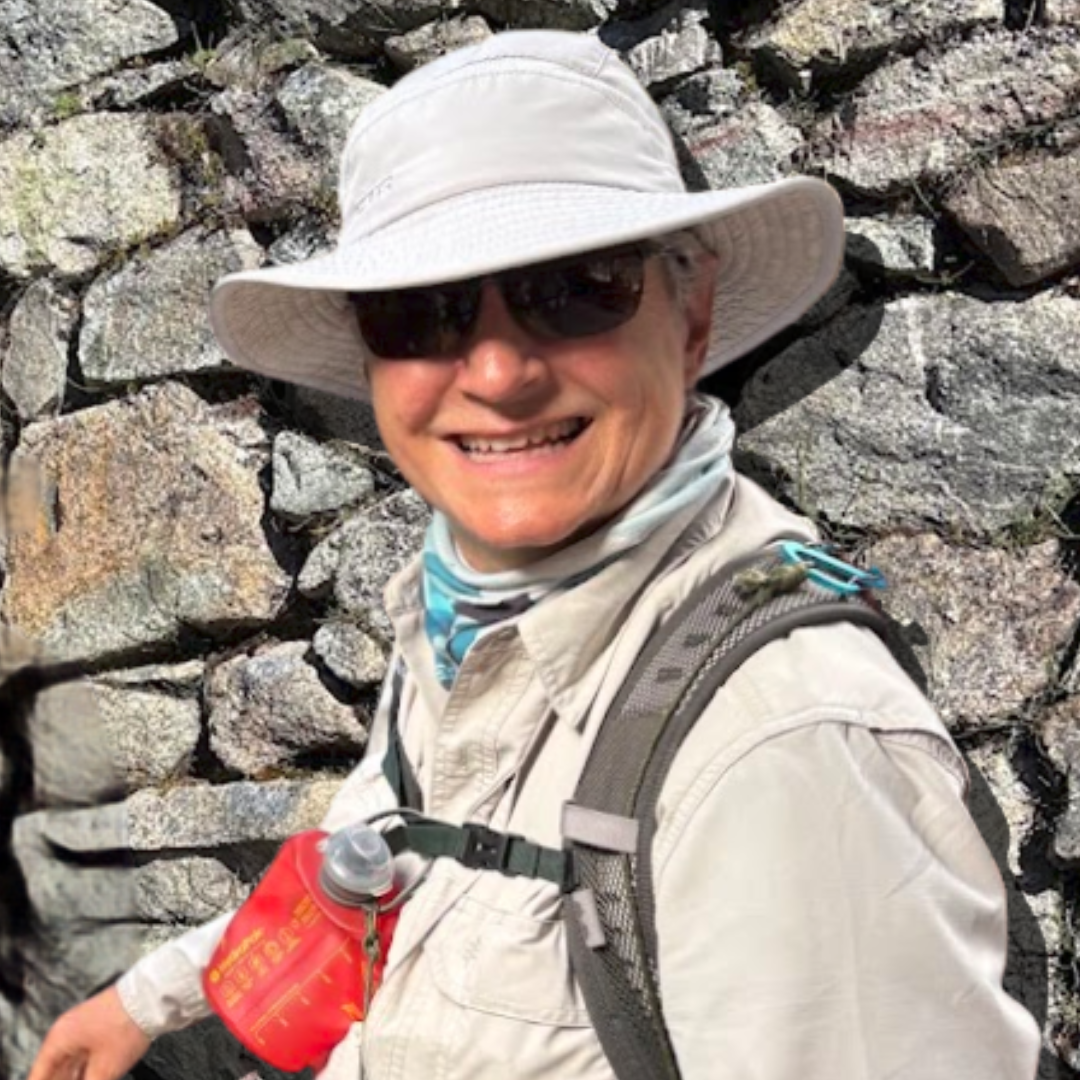
Paula Baker is a Canadian writer, retired band teacher, and librarian. She grew up on the Manitoba prairies, dividing her childhood among books, snow forts, tree-houses, bicycles, and her trumpet. After earning a Bachelor of Music Education from Brandon University and a master’s degree in gifted education from the University of North Texas, she spent thirty-five years working with young musicians and putting books into the hands of readers.
With her son, Aidan Davies, she co-authored the middle-grade Hawks fantasy trilogy, its prequel, Raptor’s Call, and the novels Dirt Town and Loftiest Intelligence. After years of inventing adventures, she turned to one of her own in Four Old Women Go to Machu Picchu, her first work of narrative nonfiction.
She lives among the mountains of British Columbia, Canada, with her husband, two kayaks, two sets of golf clubs, six bikes, eight pairs of skis, and five trumpets.
Life Is a Time-Limited Offer
What will you say yes to?
👉 Join the launch list for Four Old Women Go to Machu Picchu and get a Free Field Guide.
Did this make you think of someone?
Copy the link below and send it to a friend who might enjoy it.